Printing is one of the most transformative inventions in human history. From the earliest stone engravings that preserved knowledge across millennia to today's AI-powered systems that optimize every color, layout, and production variable in real time, printing technology has undergone a revolution that continues to reshape advertising, business communication, and visual culture. In the Saudi market, this evolution has accelerated dramatically — businesses now have access to everything from precision offset presses to 3D printers and holographic display systems. In this comprehensive guide, Window Advertising Agency traces the complete journey of printing technology through five distinct eras, examines how each stage transformed the advertising industry, and explains why smart printing powered by artificial intelligence represents the future that forward-thinking Saudi businesses must embrace today.
The story of printing begins thousands of years before mechanical presses existed. Ancient civilizations — from Mesopotamia to Egypt to China — developed techniques for reproducing text and images on durable surfaces. Stone engraving, clay tablet impressions, and woodblock carving were the earliest forms of "printing" — methods that allowed knowledge, laws, and artistic expression to be recorded and shared beyond the limitations of handwriting.
Stone printing involved carving text or images into rock surfaces, then either reading them directly or using the carved surface as a stamp to transfer ink onto papyrus, cloth, or other materials. This process was painstakingly slow — a single stone block might take weeks or months to carve — but it produced remarkably durable records that have survived thousands of years.
While no advertising agency today carves messages into stone, the principles established in this era remain foundational. The concepts of visual hierarchy, message permanence, and the power of a well-crafted symbol all trace back to these ancient techniques. The earliest brand marks — seals used by merchants to authenticate goods — were essentially stone-printed logos. Understanding this history gives modern designers a deeper appreciation for the craft behind every printed piece.
Historical Fact: The oldest known printed text is a Chinese woodblock print from approximately 868 AD, though stone seal impressions date back over 5,000 years. These early printing methods established the fundamental principle that drives the industry to this day: the ability to reproduce a consistent message at scale.
The limitations of manual engraving — extreme labor intensity, limited reproduction speed, and the skill required for each piece — created the demand that would eventually drive the invention of mechanical printing. But the core purpose never changed: communicate a message clearly, consistently, and memorably to an audience.
The invention of the mechanical printing press in the 15th century was arguably the most significant technological leap in communication history. For the first time, text and images could be reproduced rapidly, consistently, and affordably. What once took a scribe months to copy by hand could now be produced in hundreds or thousands of copies in days.
The mechanical press used movable metal type — individual letter blocks arranged into pages, inked, and pressed against paper under heavy pressure. This system enabled mass production of books, pamphlets, newspapers, and eventually commercial advertisements. The printing press did not just make communication faster — it democratized knowledge and created the very concept of mass media.
With the ability to print at scale came the birth of commercial advertising as we know it. Merchants could produce handbills, trade cards, and catalog pages to promote their goods. Newspapers carried printed advertisements alongside news. The relationship between printing and business communication that began in the 15th century has only deepened over the following six hundred years.
Key Insight: The mechanical printing press established a principle that remains true in the AI era: the most powerful printing technology is the one that delivers consistent quality at the lowest marginal cost per unit. Every subsequent printing innovation — offset, digital, and AI-powered — has advanced this same principle further.
Offset lithography, developed in the early 20th century, became the dominant commercial printing method and remains widely used today for high-volume, high-quality production. The offset process transfers ink from a plate to a rubber blanket and then to the printing surface — this indirect ("offset") method produces exceptionally clean, sharp images with consistent color reproduction across thousands or millions of copies.
For advertising agencies and businesses, offset printing became the gold standard for producing professional materials that demanded impeccable quality. Brochures, catalogs, annual reports, business cards, packaging, and large-format posters — all of these materials reached their highest quality through offset printing processes.
Industry Standard: In Saudi Arabia, offset printing remains the preferred method for premium business cards, corporate brochures, accounting books, product catalogs, and luxury packaging. The combination of professional color reproduction and cost efficiency at volume makes it indispensable for businesses that require materials reflecting quality and credibility.
However, offset printing has inherent limitations. The setup process — creating plates, calibrating color, and running test prints — requires significant time and cost before the first production copy is printed. This makes offset impractical for small quantities or projects requiring frequent design changes, creating the market need that digital printing would eventually fill.
Digital printing eliminated the plate-making process entirely. Instead of transferring ink through physical plates and blankets, digital presses apply toner or ink directly to the printing surface based on digital files. This fundamental change in process unlocked capabilities that were impossible with offset technology.
For the advertising industry, digital printing represented a paradigm shift. Campaigns could be produced in hours rather than days. Design changes could be made between print runs — or even between individual copies. Small businesses that could never afford the minimum quantities required by offset printing suddenly had access to professional-quality printed materials at any quantity.
| Feature | Offset Printing | Digital Printing |
| Setup cost | High (plates, calibration) | Minimal (direct from file) |
| Best quantity range | 1,000+ copies | 1 to 1,000 copies |
| Turnaround time | 3-7 business days | Same day to 2 days |
| Color consistency | Excellent (Pantone matching) | Very good (CMYK process) |
| Variable data | Not possible | Full personalization |
| Design changes | New plates required | Instant file update |
| Finishing options | Full range available | Growing range available |
| Cost per unit (high volume) | Lower | Higher |
| Cost per unit (low volume) | Much higher | Lower |
Saudi Market Impact: Digital printing transformed the Saudi advertising landscape by making professional print materials accessible to startups, SMEs, and entrepreneurs who previously could not afford offset minimum quantities. Today, a new restaurant in Riyadh can print 50 premium menus, a Jeddah startup can produce 100 custom brochures, and an event organizer can create unique badges for every attendee — all at competitive prices with same-day delivery.
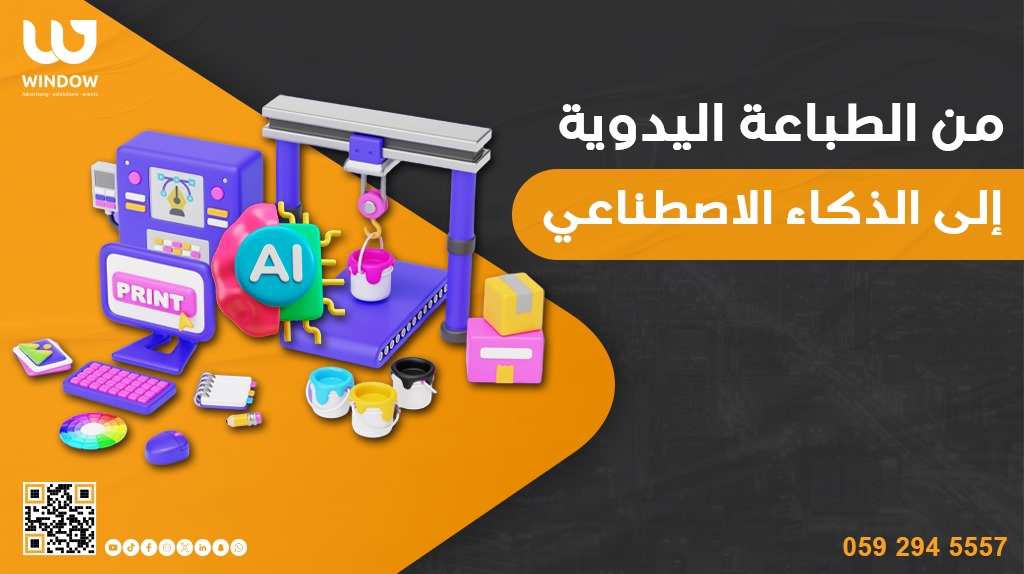
The latest revolution in printing technology is driven by artificial intelligence. AI does not replace the physical printing process — it transforms everything around it. From pre-press design optimization to real-time quality control during production to post-print analytics, AI introduces intelligence into every stage of the printing workflow.
For advertising agencies and businesses, AI-powered printing means higher quality, lower waste, faster production, and — most importantly — the ability to make data-driven decisions about every aspect of printed communication.
AI works alongside robotic automation to create fully intelligent print production lines. Robotic arms handle material loading and unloading, automated cutting and folding systems process finished prints without manual intervention, and intelligent packaging systems sort, collate, and package orders for distribution. These robotic solutions reduce labor costs, eliminate human error in repetitive tasks, and enable 24-hour production capability.
Efficiency Gain: Print facilities that implement AI-powered quality control and robotic automation report up to 40% reduction in material waste, 60% fewer quality defects, and 30% faster turnaround times compared to traditional manual workflows. For Saudi businesses, this translates directly to more competitive pricing and higher-quality output.
One of the most exciting applications of AI in advertising print is interactive road signage. AI-powered billboard systems can adjust displayed content based on time of day, weather conditions, traffic patterns, and even audience demographics detected by sensors. A single billboard location can deliver dozens of different targeted messages throughout the day, maximizing advertising impact per location. In Saudi Arabia's major cities, these intelligent advertising solutions are rapidly replacing static billboards for premium advertising placements.
Understanding the full arc of printing history provides context for where the technology stands today and where it is heading. Each era solved specific limitations of the previous one while creating new possibilities that transformed business communication.
| Era | Technology | Key Innovation | Impact on Advertising |
| 3000 BC - 1400 AD | Stone & Woodblock Printing | Durable reproduction of text and images through carving and stamping | Established the concept of consistent message reproduction; earliest brand seals and merchant marks |
| 1440s | Mechanical Printing Press | Movable metal type enabling rapid mass production of printed materials | Birth of commercial advertising; handbills, trade cards, newspaper ads; typography as design discipline |
| Early 1900s | Offset Lithography | Indirect printing via rubber blanket for superior image quality at volume | Professional brochures, catalogs, business cards, packaging with precise color matching |
| 1990s - 2010s | Digital Printing | Direct-from-file printing with no plates; variable data capability | On-demand production, personalized marketing, short-run economics, same-day turnaround |
| 2020s - Present | AI-Powered Printing | Machine learning for color optimization, predictive maintenance, automated quality control | Data-driven design, zero-defect production, interactive signage, robotic automation |
| Emerging | Smart Printing (Digital + AI) | Fully integrated digital-AI workflows with IoT connectivity and sustainability focus | Personalized mass production, augmented reality integration, eco-friendly materials, demand forecasting |
The Pattern: Every major printing revolution followed the same trajectory — a new technology eliminated a bottleneck from the previous era, reduced cost per unit, increased speed, and opened new creative possibilities. AI-powered printing continues this pattern by eliminating human error, optimizing resource usage, and enabling intelligent customization at any scale.
The Saudi printing and advertising market has undergone a profound transformation over the past two decades. The convergence of digital printing technology, AI-powered optimization, and increasing demand for high-quality marketing materials has created an environment where businesses of all sizes can access world-class printing services at competitive prices.
Market Reality: Saudi businesses that continue relying on outdated printing methods face a growing competitive disadvantage. As competitors adopt digital and AI-powered printing solutions, they achieve faster turnaround, lower costs, and higher quality — capturing market share from businesses still bound by traditional production constraints.
Beyond traditional flat printing, the Saudi advertising market has embraced a range of advanced technologies that add new dimensions — literally — to business communication and brand presentation.
Three-dimensional printing has moved from industrial prototyping into mainstream advertising applications. In Saudi Arabia, 3D printing is now used to create raised lettering for storefronts and building signage, custom promotional products with detailed brand logos, architectural scale models for real estate marketing, trade show display pieces that customers can touch and interact with, and prototype packaging designs for product launches.
The tactile quality of 3D-printed elements adds a dimension of engagement that flat printing cannot match. When a customer runs their fingers over raised lettering on a sign or holds a custom-printed promotional item, the brand experience becomes physical and memorable.
The most cutting-edge advertising applications in Saudi Arabia now include moving display models that attract attention through motion in retail and exhibition environments, holographic advertisements that create floating 3D images without glasses for premium brand experiences, interactive touchscreen displays that combine printed brand elements with digital engagement, and augmented reality integration where printed materials trigger digital content when viewed through a smartphone camera.
Saudi Market Trend: The Kingdom's Vision 2030 initiatives and the expansion of entertainment, tourism, and retail sectors are driving unprecedented demand for advanced signage and display solutions. Businesses investing in these technologies now are positioning themselves at the forefront of the Saudi advertising market's next growth phase.
The future of printing is not a choice between traditional and digital, or between human craft and artificial intelligence. It is the intelligent integration of all available technologies into unified workflows that deliver the best possible result for every specific application.
Smart printing — the convergence of digital production capability with AI-powered optimization — represents the next era of the industry. In this model, every aspect of the printing process is connected, monitored, and continuously improved by intelligent systems.
The Convergence: Smart printing does not make traditional skills obsolete — it amplifies them. A designer's creative vision is enhanced by AI-powered layout recommendations. An offset press operator's expertise is supported by predictive maintenance alerts. A project manager's planning is informed by AI production forecasts. The future belongs to printing partners who master both human expertise and artificial intelligence.
Window Advertising Agency has spent over 25 years building comprehensive printing capabilities that span the full spectrum — from traditional offset excellence to the latest AI-powered and 3D printing solutions. This breadth of capability, combined with deep understanding of the Saudi market, makes Window the partner of choice for businesses that demand the best in printing quality, innovation, and service.
25+ Years of Printing Excellence: Window Advertising Agency has produced millions of printed pieces for hundreds of Saudi businesses — from startup business cards to multinational corporate catalogs. Our commitment to adopting the latest printing technology ensures that every client benefits from the quality, speed, and cost advantages that modern production delivers.
The printing industry has traveled an extraordinary journey from stone engravings to artificial intelligence. At every stage, the businesses that thrived were the ones that embraced the latest technology while maintaining the highest standards of craft and quality. Window Advertising Agency embodies this principle — combining decades of expertise with cutting-edge innovation to deliver printing solutions that set the standard in Saudi Arabia.
From premium offset brochures to AI-optimized campaigns and 3D signage, Window Advertising Agency delivers the full spectrum of modern printing technology. Let us show you what 25+ years of expertise combined with the latest innovations can achieve for your brand.
Get Your Printing Consultation
Printing technology evolved through five major stages: stone and manual engraving in ancient civilizations, the mechanical printing press invented in the 15th century, offset printing for high-quality mass production, digital printing for instant small-quantity output, and AI-powered printing that uses data analysis and design optimization for smart, automated results. Each stage solved limitations of the previous era while opening new creative and commercial possibilities.
Traditional printing includes manual stone engraving and offset lithography, which require physical plates and extensive setup time. Modern printing encompasses digital printing for flexible, on-demand production and AI-powered printing that automates color adjustment, design optimization, and quality control. Modern methods offer faster turnaround, lower minimum quantities, and data-driven customization that traditional methods cannot match.
AI has transformed printing through automatic color correction and calibration, predictive maintenance for press equipment, design optimization based on audience data, robotic automation for finishing and packaging, and interactive advertising solutions like smart road signs. AI reduces waste, improves consistency, and enables personalized mass printing at scale — delivering higher quality at lower cost.
3D printing creates three-dimensional objects layer by layer from digital models. In advertising, it produces raised lettering for signs and storefronts, custom promotional products with brand logos, architectural models for real estate marketing, and unique display pieces for exhibitions and retail environments. It adds a tactile dimension that flat printing cannot achieve, creating more memorable brand experiences.
The Saudi market currently uses advanced digital printing for brochures and marketing materials, large-format printing for billboards and building wraps, 3D printing for signage and promotional items, LED and electronic signage for dynamic advertising, and holographic displays for premium brand experiences. The market is rapidly adopting AI-driven solutions for competitive pricing and faster production cycles.
Offset printing excels at large-volume runs of brochures, catalogs, and business cards with consistent color quality and lower per-unit cost at high quantities. Digital printing is ideal for small to medium runs, variable data printing, and quick turnarounds with no plate setup required. For most Saudi businesses, a combination of both methods provides the best balance of quality, speed, and cost.
The future of printing lies in smart printing that combines digital technology with artificial intelligence. This includes fully automated print workflows, real-time quality monitoring, personalized mass production, sustainable eco-friendly inks and substrates, augmented reality integration, and IoT-connected printing systems that optimize production based on demand forecasting.
Window Advertising Agency offers integrated printing services that combine traditional expertise with the latest AI-powered technology. With over 25 years of experience, Window provides end-to-end solutions from design to production, maintains Saudi design and print quality standards, offers competitive pricing through efficient smart workflows, and delivers everything from business cards and catalogs to 3D signage and holographic displays.