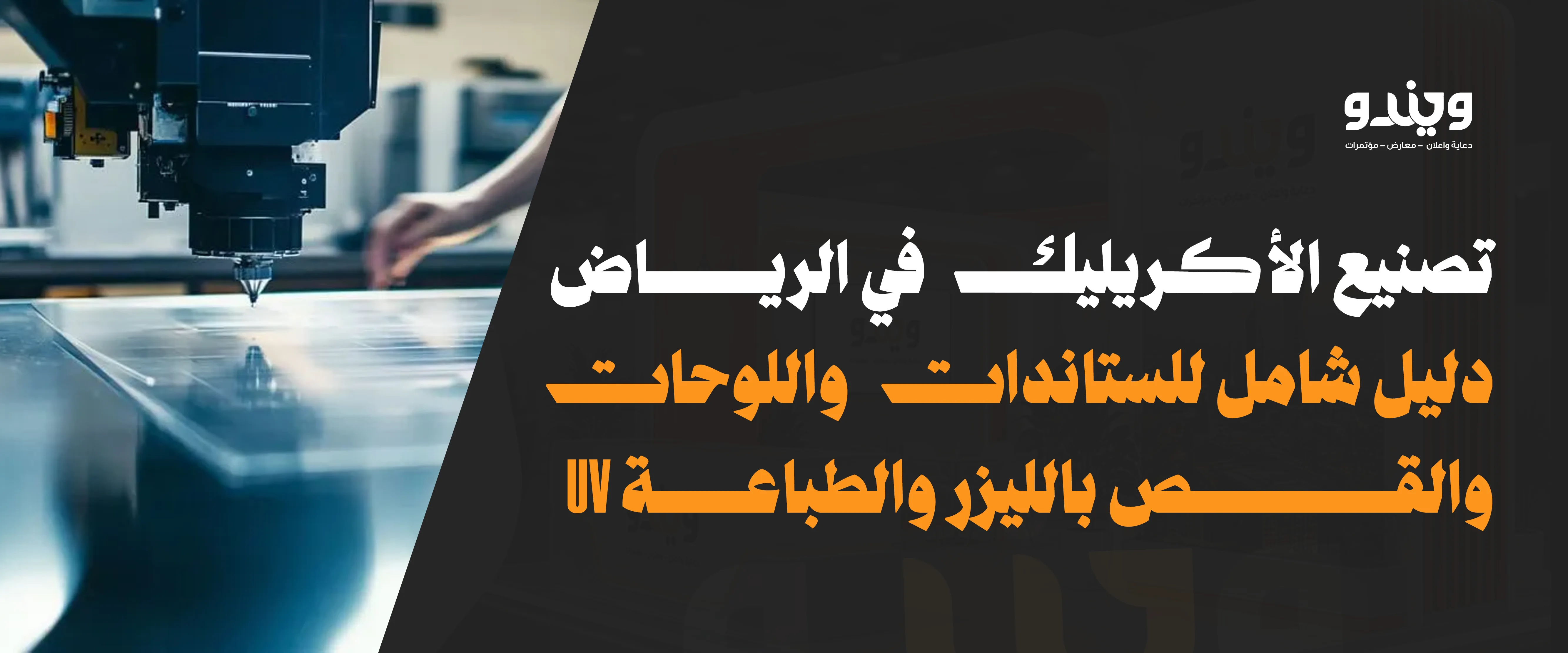
Looking for a company that manufactures custom acrylic products in Riyadh? Whether you need a display stand, a sign carrying your logo, a clear box, raised letters, or a custom piece, acrylic executes a wide range of ideas combining an elegant look with manufacturing precision.
In advertising, materials are no longer limited to traditional signs and printed pieces; cuttable, formable, printable materials are now central to promotional product design and display solutions in shops, offices, exhibitions, and events. That's where custom acrylic manufacturing comes in — turning an idea or visual identity into an actual product with sizes, colors, and finishes suited to the client's needs.
At Window Advertising Agency, we apply acrylic across advertising and manufacturing solutions — from stands and holders to signs, logos, display boxes, and custom pieces — depending on each project's requirements.
Acrylic, technically known as Polymethyl Methacrylate (PMMA), is an engineering plastic known for its ability to be produced with a high degree of transparency, alongside availability in multiple colors and finishes. Its key properties include high transparency, a range of colors and finishes (clear, colored, white, black, frosted, mirror), precise laser-cutting capability, heat-forming potential, print and engraving compatibility, and a professional look suited to display inside companies, offices, and stores.
Why this matters: Scratch, impact, and heat resistance vary by acrylic type, thickness, and how it's used — choose the right spec for the actual purpose rather than assuming all acrylic sheets perform the same.
Acrylic offers solutions beyond the traditional sign — it can manufacture a complete product that serves a practical function while presenting the brand professionally:
Acrylic and PVC are not the same material.
| Comparison | Acrylic (PMMA) | PVC |
|---|---|---|
| Transparency | High-quality clear | Usually opaque |
| Look | Clear, colored, varied finishes | Varies by sheet type |
| Common use | Stands, display boxes, signs | Signs and setups |
| Forming | Laser-cut, heat-formable | Varies by formulation |
Which fits your project? If your goal is a clear box or a holder that displays the product visibly, acrylic is a good fit. If you need an opaque sign or a piece made from foam PVC, PVC may suit better. The right call depends on actual use, not the material's name alone.
Acrylic sheets vary by manufacturing method and appearance: clear for display boxes and holders; white and black for signs and bases needing a solid color; colored for products matching brand identity; frosted for a non-glossy look; mirror for decorative pieces needing a reflective surface; and cast or extruded for applications with specific cutting and finishing needs. The choice depends on cutting, printing, and thickness requirements — not one type being universally "best."
A common market size is roughly 122×244 cm, though availability should be confirmed before finalizing the design. Common thicknesses include 2, 3, 5, 6, 8, and 10 mm, with thicker sheets available depending on supply. Thickness shouldn't be chosen by size alone — consider the product's weight, mounting method, and whether it needs bending or repeated use.
Display stands are among the most prominent uses of acrylic in advertising, helping organize products and information while allowing custom sizes, shapes, and logo placement. Examples include product display stands, brochure holders, business card holders, menu holders, QR code stands, and multi-tier stands.
Acrylic suits signs, logos, and raised letters for offices, companies, and stores — company name signs, reception signs, directional signage, and multi-layer logos. Signs can be clear or colored, with printing or engraving, and lighting added where the design calls for it.
From our work: if your project centers on a storefront or company name letters, see our full guide on raised letters in Riyadh, which weighs acrylic against stainless steel, aluminum, and brass. You can also check our embossed letters & illuminated letter signs service directly.
Custom-sized display boxes and cases offer clear practical value when the goal is visible content with organized pieces: product display boxes, memorabilia cases, suggestion/donation boxes, and custom gift boxes. Define whether the box is for display only or for repeated use, since that affects thickness and design.
Acrylic suits recognition pieces and gifts needing a distinctive design and customized names, logos, and dates — recognition awards, conference memorabilia, and company models. Result quality depends on design consistency, cutting precision, and print or engraving quality.
Professional acrylic manufacturing moves through sequential technical stages:
Multiple techniques can be combined in one product — for example, a laser-cut stand with a UV-printed logo, or an award combining cutting, engraving, and printing.
Material choice isn't just about color or thickness — consider function, use location, dimensions, required transparency and color, design details, and quantity needed.
Pricing factors: there's no fixed price for all acrylic products; cost depends on material type, thickness and size, design complexity, cutting/printing/finishing, and quantity. For an accurate quote, send a reference image or draft design with dimensions and quantity.
Acrylic enables transparent or colored products with cutting, forming, printing, and engraving capability, and can suit as an alternative to glass or some wood and metal products. But that doesn't mean it replaces these materials in every situation — another material may suit better when a project needs high heat or load resistance. Acrylic is also a plastic, so not every acrylic product is automatically eco-friendly.
When a product is tied to a brand identity, a campaign, or an exhibition setup, it's not just about manufacturing a piece of plastic — it requires understanding the final use, logo placement, and coordination with other promotional materials. This is where a specialized agency matters, one that studies the product within its marketing context.
At Window Advertising Agency, we apply acrylic and manufacturing techniques to advertising solutions for companies, stores, and exhibitions — from design through cutting, printing, and finishing.
Window Advertising Agency — 25+ years of design, manufacturing, and execution experience in Riyadh and Saudi Arabia.
Acrylic (PMMA) and PVC are different materials. Clear acrylic is known for its clarity, while PVC sheets vary between solid and foam types, each with suitable uses depending on the product's function.
Yes — a stand can be designed to the size and display function needed, with the logo added by printing or engraving and thickness chosen based on size and use.
It depends on the box's dimensions, the weight it carries, and how often it's used; smaller boxes need less thickness than large or repeatedly-used display boxes.
Yes, through direct UV printing — some designs need a white ink layer underneath the colors for the logo to read clearly against the transparent background.
Price is affected by material type, thickness and size, design complexity, cutting or printing method, and quantity needed, plus packaging and delivery if included.