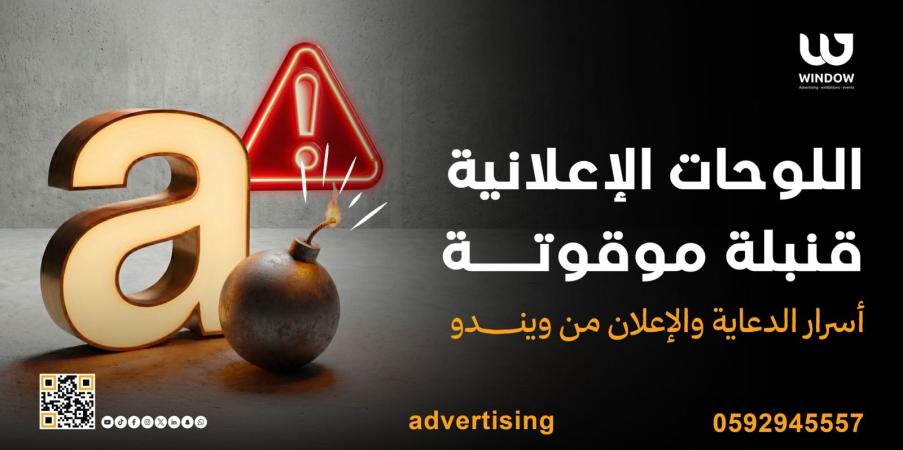
Why do over 60% of business owners regret choosing the cheapest option for their signage? From Window Advertising Agency's 25+ years of experience in the Saudi market — working with government entities, major corporations, and SMEs — we've observed a troubling pattern: signs that turn into dilapidated structures or electrical hazards within just 6 months of installation. In this comprehensive guide, we reveal the technical secrets most business owners don't know — from metal selection and coating treatments to LED quality and protection systems — so you can make your next decision with confidence.
The first thing a client usually notices is the sign's appearance and colors, but what they can't see is what matters most: the metal structure. This framework is the sign's backbone, and its quality determines whether the sign will serve you for 10 years or 10 months.
Many workshops use regular iron because it's cheap. The problem is that regular iron begins rusting as soon as it's exposed to moisture and heat — both constant elements in Saudi Arabia's climate. Galvanized steel carries a protective zinc layer that prevents corrosion and extends the frame's life by years. The cost difference is negligible compared to the massive difference in lifespan.
Regular spray paint looks fine initially but peels within months, especially under intense heat and UV exposure. At Window, we rely on Powder Coating — an industrial process where a special powder is electrostatically sprayed onto the metal, then baked in high-temperature ovens to form a solid layer fused to the surface.
But we don't stop there. We treat all frames with 3-layer insulation — internal and external primer treatment — ensuring comprehensive rust protection even in non-visible areas. This single measure explains why our signs remain in excellent condition for years while others corrode in their first season.
| Criterion | Cheap Sign | Window Sign |
|---|---|---|
| Metal type | Regular iron | Galvanized steel |
| Treatment | Spray paint | Powder coating |
| Insulation | None or single layer | 3-layer insulation (internal + external) |
| Rust resistance | 6–12 months | 8–15 years |
| Total cost (5 years) | Higher (replacement + repairs) | Lower (virtually no maintenance) |
Real-world warning: A sign with a regular iron frame and spray paint in Riyadh's climate starts showing rust within 6 months. After a year, it becomes a structural hazard — especially if it's a protruding or elevated sign. The initial savings turn into doubled costs when replacement is needed.
Lighting is the soul of a sign — especially at night when visibility matters most. The biggest deception in the signage market happens in the lighting system: reducing the number of LED modules to save money.
Price-competing workshops use low-quality Chinese LED modules in fewer quantities than required. The result: a dim sign with dark patches and uneven illumination. Within months, modules begin failing — leaving some letters lit and others dark.
At Window, we use high-quality LED modules (such as Samsung) with genuine wattage ratings and real warranties. The difference isn't just in brightness and even light distribution — it's in lifespan: professional LED lasts 50,000–100,000 operating hours versus only 10,000–20,000 hours for cheap alternatives.
One of the most dangerous practices we've observed in the market: manual wire-to-wire connections without insulators or professional connectors. This method is the leading cause of sign fires. A single exposed wire combined with moisture or high heat is enough to start a fire that could spread to the entire building facade.
At Window, we exclusively use professional connectors — industrially insulated, mechanically secured connectors that prevent any unsafe electrical contact. This isn't a technical luxury — it's protection for your property and public safety.
Technical fact: A genuine Samsung LED module operates at up to 150 lumens per watt, while cheap alternatives max out at 60–80 lumens per watt. This means professional LED delivers double the brightness at the same power consumption — real savings on your electricity bill with better illumination.
True quality lies in the details clients don't usually ask about — but clearly notice the effects of months after installation. Here are the critical details that separate a professional sign from a cheap one:
Signs — especially channel letters — are exposed to dust and insect accumulation over time. This buildup gradually reduces lighting brightness and gives the sign a faded appearance. At Window, we install insulating foam along internal edges to prevent dust and insects from entering while maintaining the ventilation needed to prevent moisture condensation.
The letter face is the illuminated surface visible to the public. Pure acrylic (PMMA) is the ideal choice for small and medium letters — featuring 92% light transmittance and excellent color stability. However, for large letters (over 1 meter), acrylic becomes brittle and prone to cracking, so we use Polycarbonate (Lexan), which offers 250 times the impact resistance of acrylic with good light transmittance.
Outdoor signs are exposed to rain and humidity. Water ingress causes serious electrical damage and component corrosion. Professional signs are sealed with industrial silicone at every junction point, with a structural design that allows any seeping water to drain rather than pool.
Heat accumulated inside the sign — from sunlight and LED heat itself — dramatically shortens electronic component lifespan. Professional signs include engineered ventilation openings with dust filters that allow air circulation without admitting contaminants.
| Technical Detail | Cheap Sign | Window Sign |
|---|---|---|
| Dust sealing | None | Internal insulating foam |
| Letter face | Low-grade acrylic or polyethylene | Pure PMMA acrylic / Polycarbonate for large sizes |
| Waterproofing | Standard adhesive | Industrial silicone + water drainage |
| Ventilation | Completely sealed | Engineered openings with dust filters |
| Electrical connections | Manual wire-to-wire | Professional insulated connectors |
A sign's responsibility doesn't end at installation — the operational phase determines its actual lifespan. A daily observation we make: signs left illuminated in broad daylight for months because they lack a control system.
Running a sign 24 hours non-stop doubles electricity consumption with zero benefit (nobody reads an illuminated sign at noon under direct sunlight) and dramatically accelerates LED degradation. A smart timer automatically activates lighting at sunset and switches it off at dawn (or at customized times). The electricity savings alone cover the timer's cost within weeks.
The transformer (driver) converts 220V mains power to the low voltage LED modules require. Cheap workshops use non-insulated internal transformers that fail at the first drop of rain or temperature spike. At Window, we use fully waterproof transformers rated IP65 or higher, with built-in overload and short-circuit protection.
Quick math: A medium channel letter sign consumes approximately 200 watts. Without a timer (24 hrs × 365 days) = 1,752 kWh/year. With a timer (10 night hours × 365 days) = 730 kWh/year. Difference: 1,022 kWh/year — that's over 58% savings on the sign's annual electricity bill.
With increasingly strict regulations from municipalities across Saudi Arabia, commercial signage has become the first test of your business's professionalism in the eyes of regulatory authorities. A non-compliant sign means financial penalties and immediate removal — and sometimes business suspension.
Common scenario: A business owner installs a sign from a cheap workshop without a permit and with non-compliant dimensions. Weeks later, they receive a violation notice and removal order. They lose the full cost of the first sign and must pay for a new compliant one — paying twice. The mistake wasn't the "sign" — it was the agency that didn't understand the regulations.
At Window, we have a dedicated municipality compliance specialist who reviews every sign project before manufacturing begins. We guarantee 100% compliance with all municipality requirements — protrusion, dimensions, language, and safety — and handle the permit process on your behalf.
A sign is not a space for cramming information — it's a visual facade that must capture attention and deliver a clear message within seconds. The common design mistakes we see daily waste entire budgets:
Window's design team studies each project independently: optimal font size for the viewing distance, word composition with attention to aesthetic spacing, color selection based on color theory and brand identity, and identifying the essential information that deserves prominence. The result: a sign that captures the eye and delivers its message instantly.
The signage industry is evolving rapidly, and modern technologies are opening new possibilities in display and impact. Window embraces the latest innovations to deliver signs that go beyond the ordinary:
Smart investment: A professional sign with modern technologies may cost 30–40% more than a cheap one, but it lasts 5–8 times longer and requires 80% less maintenance. Over 5 years, the total cost of a professional sign is lower than replacing cheap signs two or three times.
Window Advertising Agency is not just a fabrication workshop — we're a partner ensuring your sign represents your brand at its best and lasts for years:
Window Advertising Agency — 25+ years of professional sign manufacturing in Riyadh. Uncompromising quality, real warranty, and 100% municipality compliance.
A sign manufactured to professional specifications (galvanized steel + powder coating + Samsung LED + professional connectors) lasts 8 to 15 years with excellent performance and minimal maintenance. By comparison, a cheap sign may need complete replacement within one to two years.
Spray paint is a liquid layer that dries on the surface and peels easily with heat and sunlight. Powder coating is an electrostatically sprayed powder baked in high-temperature ovens, forming a solid layer fused to the metal — many times more resistant to scratching, rust, and UV than spray paint.
Yes, absolutely. Running 24 hours doubles electricity consumption with no benefit (nobody notices a lit sign during daytime) and dramatically accelerates LED degradation. A timer saves over 58% of the sign's annual electricity bill and more than doubles LED lifespan.
Municipality requirements cover protrusion limits (typically 20 cm), maximum area by business type and location, Arabic language ratios, and electrical safety. At Window, our dedicated specialist reviews all requirements before manufacturing, and we handle the permit process on your behalf to ensure zero violations.
The leading cause is manual wire-to-wire connections without insulated connectors, causing electrical contact in the presence of moisture or heat. Other causes include cheap non-waterproof transformers and missing independent circuit breakers. Window uses professional connectors, IP65-rated transformers, and independent circuit breakers for every sign.
The cause is typically a reduced number of LED modules below what's needed (to cut costs), or using cheap low-brightness modules. The solution is reinstalling LED at adequate quantities with professional-grade modules (such as Samsung) and engineered distribution ensuring even illumination across the entire letter surface.
Cost depends on the sign's size, materials, and required technologies. As a rule of thumb, a professional sign costs 30–40% more than a cheap one but lasts 5–8 times longer and requires 80% less maintenance. Over 5 years, investing in quality is the smartest financial decision. Contact us for a detailed quote tailored to your requirements.