A backdrop is the first thing the camera sees and the last thing guests remember
Open any photo from a press conference, a graduation ceremony, or a trade show in Riyadh, and the eye goes straight to the background. A backdrop isn't just a printed sheet hung behind a speaker — it's the space where a brand's identity repeats in every photo, every video clip, and every post shared after the event ends. An event without a well-designed backdrop quietly loses a marketing opportunity that would otherwise repeat itself thousands of times.
Many companies spend heavily on décor, lighting, and sound, and leave the backdrop as an afterthought. The result is a distorted logo, colors that don't match the brand, or a cluttered design that buries the core message. Yet the backdrop is one of an event's least expensive elements — and one of its most visible, living on in photos that stay online for years.
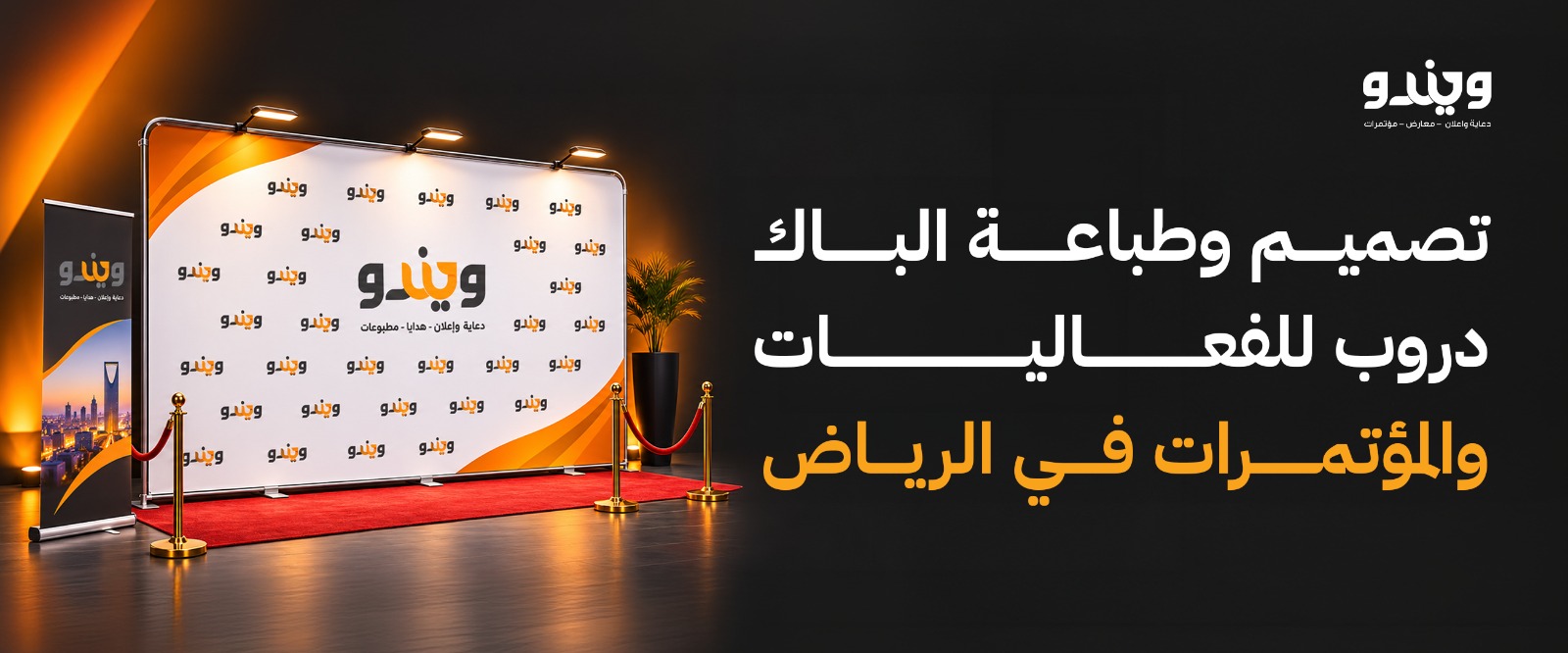
A backdrop is a printed or constructed background installed behind a photo area or stage at an event, usually carrying the organizer's or sponsor's logo along with brand identity elements. It often follows a repeating "Step & Repeat" pattern, the kind seen at major press conferences and award ceremonies.
Its role isn't purely aesthetic. A backdrop turns every photo shared from the event into free, repeating advertising space: guest photos, social media coverage, press reports, and even staff keepsake pictures. While the event itself ends within hours, these photos stay in circulation for years — which is exactly what makes backdrop design quality a long-term investment rather than a passing operational line item.
Why this matters: at major conferences and exhibitions in Riyadh with heavy press coverage and photography, the backdrop appears in more photos than almost any other element at the event — more than signage, more than promotional gifts.
| Type | Description | Best For |
| Printed stretch fabric | Wrinkle-free flexible fabric, easy to transport and install | Conferences and recurring events |
| Printed vinyl on a frame | High-resolution print on a fixed frame | Professional photography and exhibitions |
| Collapsible pop-up frame | Set up and folded down in minutes, no tools needed | Mobile and temporary events |
| Backlit LED backdrop | Internal lighting for a uniform glow | Main stages and major launch events |
| 3D embossed-letter backdrop | A dimensional logo added in front of a flat background, see our embossed letters & illuminated signage guide | Events wanting a dimensional presence |
Practical note: printed fabric is the most requested option for recurring conferences, since it folds and travels between venues without wrinkling or cracking the way some cheaper vinyl can.
Pricing factors: backdrop pricing depends on material type (fabric, vinyl, lit), size, frame type (fixed or collapsible), and how many times the logo repeats in the design. Requesting a quote with exact size and quantity gives you an accurate comparison across suppliers.
The process starts with understanding the event's nature and expected photography area, then designing the digital file at high print resolution with a clear safety margin. Next comes choosing the right material for the use case — fabric for recurring events, or vinyl for fixed exhibitions. Once the design is approved, the backdrop is printed with color quality matching the brand identity, fitted with the appropriate frame or hanging system, and delivered ready for fast on-site installation with clear instructions for the event crew.
| Use | Approximate Size |
| Individual photo area at entrance | 2 × 2.4 meters |
| Speaker stage background | 3 × 2.4 meters |
| Press conference with repeating pattern | 4 × 3 meters and larger |
| Exhibition booth background | Depends on booth footprint |
These dimensions are estimates and vary by venue size and camera setup; a site visit or sharing the event floor plan remains the most accurate way to confirm the final size.
Choose a company with hands-on experience in events similar to yours in scale and character, and one that shows clear, high-quality past work. Confirm their ability to deliver within a tight timeline if your event is coming up soon, and discuss material options suited to the venue — indoor or outdoor. A full-service company that covers backdrops alongside booths and stands saves you the effort of coordinating multiple suppliers for one event.
From our work: Window Advertising Agency has designed backdrops for major conferences and exhibitions across Riyadh, from medical conferences to corporate events, including design, printing, and on-site installation on event day.
A backdrop is a larger, fixed background typically used behind a stage or group photo area, while a roll-up is a single, collapsible promotional stand suited for individual display points. Read more about roll-up and pop-up stands.
Yes, if the design is general to the brand without a specific event date or logo, and made from a durable material like heavy fabric or thick vinyl.
It depends on size, material, and quantity, but it can often be completed within a few days once the final design is confirmed early.
This varies by agreement; some projects include full on-site installation, while others are delivered ready for the client's own team to set up.
Reinforced vinyl or UV-treated fabric, to withstand sun and wind without the colors deteriorating quickly.