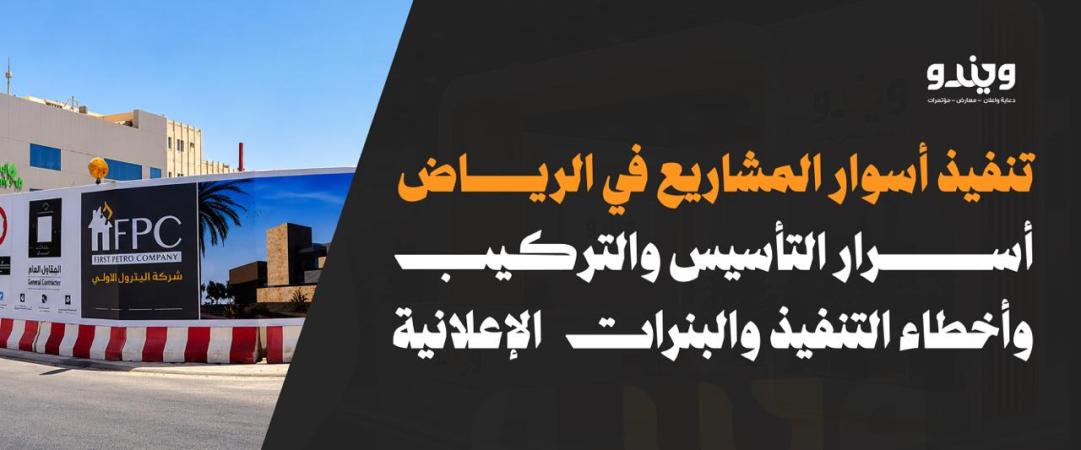
Looking for a company specialized in executing project hoarding in Riyadh, or in fencing vacant land and construction sites? If you're a landowner, a real estate developer, or a contracting-company manager, there are important technical details you should know before approving a quote and starting the work.
A successful project hoarding wall doesn't depend only on installing the steel frame, the plywood, and printing the advertising banner. It starts with a site survey, establishing ground levels, planning the concrete footings, choosing the right steel sections, aligning the wall, and then installing the plywood panels and banners in a way that fits the site's actual conditions.
Some of the mistakes that happen during hoarding installation don't show up as soon as the work is finished. The problem can start with how the footings were laid out or with uncorrected ground levels, and only appear later as a leaning wall, uneven panels, or a poorly secured banner.
In this guide, we walk through the key stages of executing advertising project hoarding in Riyadh, fencing vacant land, and installing banners on construction sites, and we outline the technical mistakes that can raise costs or affect the quality of the work — plus how to choose the right contractor for your project.
A project hoarding wall is no longer just a barrier around the land or a way to separate a construction site from its surroundings. On many real estate and commercial projects, the wall is an advertising surface that can be used to showcase the project's identity and introduce the developer or contracting company.
When the wall is built professionally, its face can display the project name, logo, architectural renderings, marketing imagery, and contact information — giving the project an organized appearance and strengthening its visibility to the public.
This surface becomes even more important when the project sits on a main road or in a high-traffic location in Riyadh, where a clear design helps passers-by recognize the project at a glance.
Reaching a professional result, though, requires combining three essential elements:
A successful hoarding wall isn't just a wall that stands upright — it's an integrated build that accounts for technical requirements, final appearance, and advertising value.
One of the most important stages in executing project hoarding in Riyadh is inspecting and studying the site before work begins. Starting to install footings or steel without understanding the land's nature can cause problems that appear later — differing heights, a leaning wall, or the need for costly rework.
Before execution, the following points deserve attention:
Ownership boundaries, site plans, and approved surveys should be reviewed before fixing footing locations. Building along an incorrect line can lead to costly adjustments or boundary-related issues.
It's important to confirm whether the land is flat or has rises and dips. Even a visible slope or small differences in level can affect how footings are spaced, column heights, and the final shape of the wall.
Proper surveying or site measurement helps identify level differences and gives a clear picture of the wall's height from one end to the other.
Concrete footing locations should be coordinated with column positions, steel section spacing, and panel dimensions — based on the design and project requirements, rather than spacing things out arbitrarily.
Underground utility routes, obstructions, and excavation conditions should be verified before executing the footings, with the necessary precautions taken to protect existing utilities.
The wall's length and height, the locations of corners and gates, the materials to be used, the banner-fixing method, and lighting locations (if any) should all be agreed on in advance.
Before work begins, the municipal requirements and permits that apply to the type of site and the fencing required should be reviewed.
These steps help catch problems before execution starts, reduce the likelihood of rework, and give the installation team a clear picture of how the wall should be set up and built.
Concrete footings — sometimes referred to in the market as "pours" — are among the most important elements in anchoring a project hoarding wall. Their success depends on how well their design fits the site's conditions and the structure being used, not simply on the volume of concrete poured.
Spacing between footings should be set according to the wall's design, column locations, steel section dimensions, and expected loads. Poorly planned spacing can make it difficult to install the frame or to fix plywood panels evenly.
If ground levels aren't measured before the footings are executed, differences can appear later in column heights or in the wall's line, after the steel and wood have been installed. For this reason, levels and reference lines should be established before pouring, and footing locations and heights should be checked against the execution plan.
Footing details and column-fixing methods vary depending on soil conditions, wall height, the approved design, and site conditions. The design may call for buried footings, above-ground footings, or the use of base plates and anchor bolts, depending on the appropriate structural system. A single method shouldn't be applied to every project, since the requirements of each site can differ.
Footing dimensions, depth, and reinforcement — where needed — should be determined according to design requirements, soil conditions, and expected loads. Using uniform dimensions for all hoarding walls without a technical assessment isn't recommended.
The real secret: the more precisely the site is surveyed, levels are set, and footings are coordinated with the steel frame, the more consistent every later installation stage becomes — and the lower the chances of rework and adjustment.
One of the most important details in executing project hoarding is choosing the right steel sections and defining the locations of columns and horizontal cross-members before installation begins.
Vertical sections form part of the wall's load-bearing structure, while horizontal cross-members help tie the frame together and provide fixing points for the plywood panels, depending on the design.
The quality of execution depends on several factors:
Some projects may call for sections such as H-beams or other steel profiles, depending on the wall's nature, the design, and project requirements. No single section can be considered the best choice for every case — the section, its size, thickness, and fixing method should all be chosen according to the technical requirements.
The right steel isn't necessarily the largest — it's the section that efficiently meets the design, fixing, and safety requirements.
One mistake that can affect a wall's quality is installing plywood panels before confirming that the steel frame is straight and reviewing its heights.
The ground may be sloped, footing levels may differ, or there may be variations in column height. Once the wood is installed, the problem shows up as uneven edges or visible differences in the wall's height.
To avoid this, the following steps should be followed:
One of the most important secrets of execution is checking alignment and levels before installing the wood — not after the problem appears.
If the steel is installed without precise alignment, the team may have to dismantle sections of the wood and reinstall them, which increases time and cost and affects the uniformity of the advertising surface.
Plywood panels are used in many project hoarding walls built to carry a printed advertising surface. But the quality of the result doesn't depend on the type of wood alone — it also depends on how it's fixed and how its surface is prepared to receive the banner.
Panels should be fixed to their designated cross-members, with attention to their alignment, the consistency of the joints, and their stability along the length of the wall. Panels suited to outdoor use should also be chosen, with attention to their resistance to moisture and weather conditions according to the project's specifications.
One detail that should be planned in advance is providing suitable fixing points at the ends of the plywood panels and at their joints. This may require additional steel sections, such as tube profiles, depending on the approved execution method.
If the edges aren't properly prepared, the installation team may end up fixing the banner directly into the wood without a fixing system suited to the wall — which can affect its stability and finish quality. For this reason, the banner-fixing method should be decided before the panels are installed, and the frame should be prepared accordingly.
Panels should be checked for evenness and consistent gaps between them, with any discrepancies addressed using the right technical method before the banner is installed. Unsuitable gaps or raised edges can affect how flat the installation surface is, which shows up on the printed surface afterward.
Some project hoarding walls develop bulges or ripples in the advertising banner after installation, or the banner can become damaged after a period of use.
This issue isn't always tied to print quality alone — factors such as how flat the installation surface is, the tensioning and fixing method, the material used, and wind exposure can all play a role.
Some of the most important factors to watch for:
Before installing the banner, the panel surface should be inspected and checked for evenness, gaps should be addressed, and fixing points should be prepared. The banner should then be installed using a system suited to its dimensions and the site's conditions.
A banner is a surface exposed to wind, and repeated movement can increase stress on the fixing points. Relying on the print material alone isn't enough — the integrity of the fixing system and the supporting frame matters just as much.
Banner quality doesn't mean the whole wall is high quality — the result depends on how well the materials, preparation, and installation come together.
One detail that affects execution quality is planning the locations of light fixtures, electrical wiring routes, and fixing points in advance.
If lighting locations aren't planned ahead of time, the team may have to make adjustments after the banner is installed — which can increase execution time or damage parts of the finish.
To avoid this, light fixture locations should be determined during the planning stage, along with the necessary fixing points and wiring routes, with attention to how lighting is distributed across the surface.
Light fixtures don't need to be installed before the banner on every project, but the work stages should be coordinated and the required locations prepared before final finishing. Electrical connections and light fixtures should also be suited to outdoor use and executed according to the relevant safety requirements.
Some contracting companies handle project hoarding installation in-house, relying on their own experience in steel, carpentry, or construction work. This isn't a mistake in itself, as long as the right experience, tools, and planning are in place.
The problem arises when execution begins without a sufficient understanding of the details specific to advertising project hoarding, leading to mistakes that can cause rework, higher costs, or a weaker-looking surface. Some of the most common mistakes:
Footing locations may be set by estimation, without measuring ground-level differences or coordinating footing positions with the steel columns. Once installation starts, differences in height or difficulty installing the frame appear.
The fix: measure levels and determine footing locations and the wall line before execution.
The frame may look acceptable at first, but once the plywood is installed, leaning columns or uneven heights appear.
The fix: check the alignment of the columns and cross-members, and their levels, before fixing the panels.
Panels may be installed without considering how the banner will be fixed at the edges and joints, with the problem only surfacing at the finishing stage.
The fix: coordinate the frame details, the panels, and the banner-fixing system before installation begins.
Uneven panels can create defects in the installation surface, which can affect the final appearance of the banner.
The fix: confirm that panels are flat and consistent, and address gaps before installing the banner.
The banner may be installed without accounting for its dimensions and the effect of wind on the surface and fixing points.
The fix: choose a fixing system suited to the site's actual conditions, according to the technical requirements.
The banner may be installed before lighting locations and wiring routes are determined, requiring later adjustments.
The fix: coordinate lighting and wiring work during the planning stage.
A small design may be scaled up without redistributing its elements, resulting in unclear text or inconsistent visuals along the length of the wall.
The fix: prepare a design customized to the wall's dimensions and viewing distance.
One quote may cover setup, steel, wood, printing, and installation in full, while another excludes some of these items.
The fix: compare specifications, scope of work, materials, and fixing and finishing methods — not just the total price.
Execution may begin before verifying land boundaries or the relevant regulatory requirements, which can lead to adjustments or delays.
The fix: review the requirements and permits that apply to the site before work begins.
Bottom line: general contracting experience doesn't necessarily mean specialization in advertising project hoarding. Walls that combine a steel frame, plywood, and banners require coordination between execution and finishing stages. This work can be handled in-house or through a specialized contractor, provided the necessary technical experience is in place.
Once the setup, steel frame, and plywood panels are complete, the stage of designing, printing, and installing the advertising banner begins. This stage matters just as much as the quality of execution, since the wall is a visible surface representing the project to passers-by, clients, and investors.
For the best result, the design should account for the wall's length and height and the viewing distance, distributing elements in a way that keeps the advertising message clear.
Text should be legible from the distance at which the public will view the wall. Text that's too small can make information hard to read, while oversized elements can throw off the visual balance.
The project's identity should be clearly visible, with information arranged by importance, so passers-by can recognize the project quickly.
When printing building images or architectural renderings at large scale, files need to match the print dimensions so the images don't appear blurry or low quality.
Column locations, joints, corners, and gates should be accounted for, so that words or key elements aren't awkwardly split when the banner is installed.
Consistent colors, fonts, and logo usage aligned with the project's identity help the surface look professional.
Panel dimensions, joint positions, and fixing points should be accounted for when preparing and splitting the design for printing, so key elements aren't disrupted during installation.
Designing for project hoarding requires experience with large advertising surfaces — it's not simply a matter of scaling up a design made for a small flyer.
When looking for a land-fencing company in Riyadh or a company specialized in executing advertising project hoarding, it's important to confirm that the company understands the nature of the project and can coordinate its different stages of work.
Before approving a quote, review the following points:
Price shouldn't be the only criterion. The cheapest quote isn't necessarily the least costly option in the end if the work requires repeated adjustments or replacing damaged parts.
It's best to compare quotes based on scope of work, technical specifications, materials, and execution method, so the comparison is fair and clear.
It's important to distinguish between fencing vacant land, construction-site hoarding, and project signboards, since requirements and permits can differ depending on the type of site and the work required.
Before starting execution, the relevant authority should be consulted to confirm the requirements that apply to the project.
The Riyadh Municipality (Amanat Riyadh) offers a site-protection permit for fencing vacant land, and publishes a guide outlining fencing mechanisms and related design requirements. Official sources:
It shouldn't be assumed that vacant-land fencing requirements are identical to those for every construction-site wall or advertising signboard — the requirements that apply to each case should be confirmed before execution.
At Window Advertising Agency, we believe quality work starts with understanding the client's needs and paying attention to detail, and that a successful advertising surface depends on how well execution, design, and printing come together.
With more than 25 years of experience in advertising, design, and the execution of advertising work, we deliver solutions suited to the needs of companies, real estate developers, and contracting firms.
We understand that a project hoarding wall isn't just a barrier around a site — it's part of the image the project presents to the public. That's why surveying the site, planning the execution, choosing the right materials, aligning the wall, preparing banner-fixing points, and selecting the right design are all details that help achieve an integrated result.
If you're looking for a company specialized in executing project hoarding in Riyadh, fencing land, and designing, printing, and installing banners for real estate and advertising projects, defining your project's needs precisely is the first step toward the right solution — you can request a quote and get in touch with our team to discuss your project's details.
Executing a professional project hoarding wall requires planning that starts with surveying the land and its levels, determining footing locations, choosing the right steel sections, and checking alignment before installing the plywood panels.
Next comes preparing fixing points, addressing gaps, and coordinating lighting — followed by designing, printing, and installing the banner to suit the wall's dimensions and the site's conditions.
Paying attention to these details from the start helps reduce mistakes and rework, maintains execution quality and final appearance, and turns the hoarding wall into an advertising surface that professionally reflects the project's image.
Looking to Execute Project Hoarding or Fence Land in Riyadh?
Window Advertising Agency — 25+ years of experience in design, execution, and advertising in Riyadh