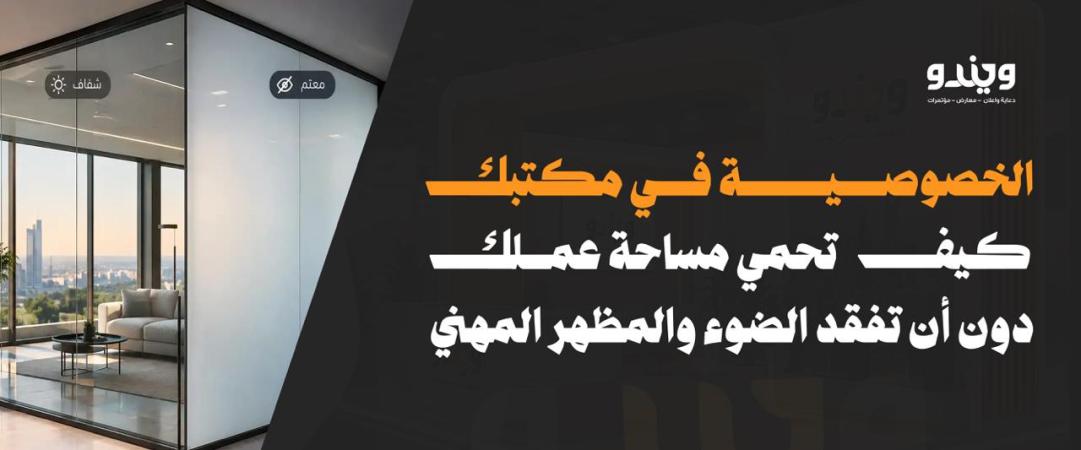
Modern offices in Riyadh have moved toward glass partitions because they bring in natural light and a sense of openness. But the same glass can turn a meeting room or a manager's office into a display window for everyone in the corridor. The right question isn't "how do I cover the glass?" but "which space needs privacy, when, and how much?" This guide walks you through the options, from frosted film to smart glass, so you can choose what suits your office, budget, and company image.
Privacy at work isn't one thing but three overlapping levels. The first is visual: who can see into the room, and what can they see? The second is acoustic: do conversations carry outside? The third is informational: are screens, documents, and whiteboards visible to anyone behind the glass? A film on glass mainly addresses the visual level, while sound needs other solutions such as acoustic insulation, and it's only fair to know that before you buy.
Then look at the spaces themselves, since they don't all need the same degree. Meeting rooms, management offices, HR, and accounting need high privacy at certain times, while reception areas and corridors are fine with partial privacy that doesn't cut off the view entirely. Once you define the level for each space, the options become clear, and you avoid paying for an over-engineered solution or one weaker than you need.
Privacy in an office isn't a luxury, either. It protects the confidentiality of negotiations and client data, helps employees concentrate, and tells visitors your company respects their information. A client who walks into a meeting room visible to everyone passing by forms an impression of your organization before the conversation even starts.
Why This Matters: The most common mistake is applying one solution to all the glass in an office. A well-planned office matches solutions to what each space does, keeping openness where it helps and closing off where it's needed.
Frosted Film: It gives the look of sandblasted glass, hiding details while letting light through. It's the most economical option, but its privacy is permanent and can't be switched off, so it suits places that never need transparency, such as archive and interview rooms.
Printed or Cut Vinyl Film: Patterns of lines, dots, or gradients, or a horizontal band at eye level carrying the company name and logo. Here privacy becomes a design element that serves your Branding, instead of a neutral curtain that says nothing. A visible band across the glass also reduces the chance of employees and visitors walking into it.
Blinds and Curtains: Flexible and manually controlled, but they collect dust, can look dated, and their mechanisms wear out over time.
Smart Film and Smart Glass: These switch between transparent and opaque at the press of a button, through a wall switch, a remote, or a link to a smart building system. The difference is that smart glass is manufactured with a PDLC layer built into it and is ordered in exact sizes, making it right for new projects or full glass replacement, while smart film is a self-adhesive film applied to existing glass without replacing it, which makes it the best fit for offices already in use. It's only honest to mention the limits: in its opaque state the glass diffuses light, blocking the view but not the sound, and it needs a power source, a driver, and concealed wiring.
You don't have to choose one solution for the whole office, either. Successful projects often combine them: printed film in corridors and reception, frosted film for archive rooms, and smart film for the main meeting room alone, so the larger spend goes where flexibility is truly needed.
Window Advantage: Window Agency runs its own factory with integrated production lines in Riyadh, so it designs, prints, cuts, and installs patterns and logos itself, including smart film for offices that need on-demand privacy without replacing their glass.
Start with five criteria: the privacy level required, how much light you want to keep, your budget, how much flexibility you need, and how much maintenance you can accept. Then ask the installer about what a photo can't show: the film's type and thickness, adhesive quality, and compatibility with your glass (standard, tempered, or double-glazed), especially under direct Riyadh sun, since some films aren't suited to every glass type. Ask about the warranty and how the edges are finished.
Don't overlook design. Frosted film applied without thought can make an office feel closed and dim, while a well-planned band in your brand colors at eye level gives you privacy and strengthens your image at once. In sunny areas, some films can also help reduce glare, which is worth asking about.
Before final approval, ask for a visual mockup of the patterns on your actual glass and, if possible, a small sample, since film can look different under your office lighting than in a catalog.
| # | Space | Usually the Best Fit |
| 1 | Meeting rooms | Smart film, or frosted film with a clear band |
| 2 | Management and HR offices | Frosted or smart film, depending on the need for transparency |
| 3 | Reception and corridors | Printed film with patterns or the company logo |
| 4 | Archive and interview rooms | Full frosted film |
| 5 | Open offices needing partial privacy | A printed band or lines at seated eye level |
Good execution starts with a site visit and accurate measurements, then thoroughly cleaning the glass, because any dust trapped under the film becomes a permanent bubble. Ask for the work to be done outside office hours, and set the delivery date clearly.
After installation, ask how long the film needs to settle before cleaning, and use a soft cloth with a non-abrasive cleaner, avoiding sharp tools. With smart film, test the switch and both states before handover, and confirm the edges are sealed away from moisture and the wiring is concealed.
Finally, remember the right question isn't "what's the cheapest film?" but "what am I getting for what I'm paying, and how long will it last?" A good film that lasts years without yellowing or peeling is far more economical than a cheap one replaced after a season. With several branches, keep patterns and colors consistent through one agency.
| # | Final Evaluation Point | Why It Matters |
| 1 | Defining the privacy level for each space | Prevents spending on a solution that doesn't fit the function |
| 2 | Matching the type to your existing glass | Protects the glass and extends the film's life |
| 3 | Design and brand identity | Turns privacy into a visual message |
| 4 | Installation and edge quality | Prevents bubbles and peeling |
| 5 | Warranty and maintenance | Determines the real long-term cost |
Looking for a Privacy Solution That Fits Your Office Glass in Riyadh?
Window Agency — 25+ years of experience in design, execution, and manufacturing in Riyadh
It hides details and faces to a large degree while keeping the light, but it may still show shadows and general movement, so test a sample on your own glass first.
Yes. Smart film is self-adhesive, applied to existing glass and connected to power and a switch, and it usually costs less than custom smart glass.
No; it addresses visual privacy only. If acoustic insulation is required, you need a separate solution such as double glazing or insulating materials.
Usually yes, when a good film is removed properly, but it depends on the film, the adhesive, and how long it has been in place, so ask the installer in advance.
Yes. The logo can be combined with patterns or a band in your brand colors, joining privacy with brand recognition.