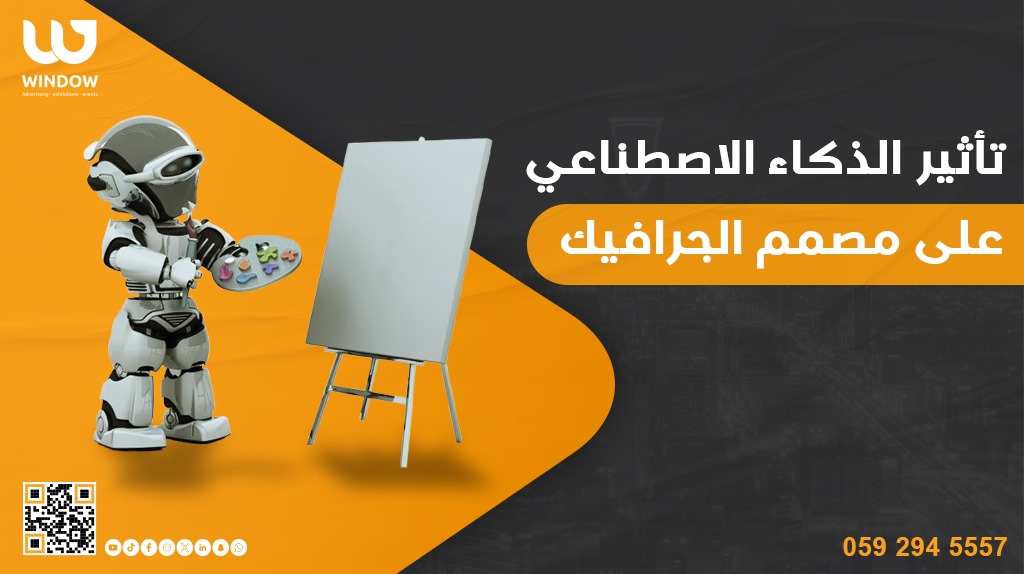
Artificial intelligence is no longer a futuristic concept — it is a daily reality reshaping industries worldwide, and graphic design is no exception. AI-powered tools can now generate images, suggest color palettes, create layout variations, and even produce complete visual designs in seconds. For graphic designers, this raises an urgent question: is AI coming to take their jobs? The answer is far more nuanced than the headlines suggest. In this comprehensive guide, Window Advertising Agency examines exactly how AI is transforming graphic design, which tasks it can handle, which ones it cannot, and why the future belongs to designers who embrace AI as a powerful partner rather than fear it as a replacement.
AI in graphic design is not science fiction. It is already embedded in the tools designers use every day. From Adobe's Firefly and Sensei engines to standalone platforms like Midjourney, DALL-E, and Canva's AI features, artificial intelligence is actively reshaping how visual content is created, edited, and optimized.
At its core, AI in design works by analyzing vast datasets of existing images, patterns, colors, and shapes. It learns visual relationships — which color combinations feel harmonious, which layouts draw the eye, which font pairings create contrast. It then applies these learned patterns to generate new visuals, suggest improvements, or automate repetitive production tasks.
The scope of AI application in graphic design today includes several key areas:
Industry Reality: According to industry surveys, over 60% of designers now use at least one AI-powered tool in their workflow. The adoption rate is accelerating as AI tools become more accessible, more affordable, and more capable — making it essential for every designer to understand what AI can and cannot do.
Understanding how AI works in design is the first step toward using it effectively. AI is not a magic button that produces perfect designs. It is a pattern-recognition engine that excels at speed and volume but fundamentally lacks the human qualities that make design meaningful.
The short answer is no — AI cannot fully replace graphic designers. But the longer answer requires understanding exactly what AI can and cannot do, and why the distinction matters for the future of the profession.
AI excels at tasks that involve pattern recognition, repetition, and data processing. It can analyze millions of designs and extract visual rules. It can apply those rules to generate new outputs faster than any human. It can produce variations, resize assets, and maintain consistency across formats at a scale that would be impossible manually.
But design is not just pattern recognition. Design is communication. It is the deliberate use of visual elements to convey a specific message to a specific audience in a specific context. This requires understanding human psychology, cultural nuance, emotional triggers, market dynamics, and the unique strategic goals of each client and campaign.
The Critical Difference: AI can produce a visually attractive image. But it cannot tell you whether that image will resonate with Saudi consumers versus European consumers, whether it aligns with a brand's five-year positioning strategy, or whether the emotional tone matches the campaign's psychological objectives. These decisions require human judgment, experience, and cultural intelligence that no algorithm can replicate.
The designers most at risk are those whose work is entirely mechanical — those who only resize images, swap colors in templates, or produce formulaic designs without strategic thinking. For these tasks, AI is already faster, cheaper, and often more consistent. But for designers who bring strategic thinking, originality, and cultural understanding to their work, AI is not a threat — it is a tool that amplifies their capabilities.
Not all design work carries the same creative weight. Many tasks in a typical design workflow are repetitive, rule-based, and time-consuming — exactly the kind of work AI is built to automate. Recognizing which tasks fall into this category helps designers focus their energy where it matters most.
The bulk of time many designers spend is not on creative ideation but on production — adapting an approved design into dozens of sizes, formats, and variations. AI is already handling these tasks with increasing speed and accuracy:
The Pattern: The tasks AI handles best share a common trait — they follow rules. When there is a clear input, a defined process, and a predictable output, AI outperforms humans on speed and cost. The moment a task requires judgment, cultural context, or creative risk-taking, AI reaches its limits.
While AI continues to automate production-level tasks, there is an entire category of design work that remains fundamentally human — and will stay that way for the foreseeable future. These are the tasks that require original thinking, emotional intelligence, and deep understanding of human behavior and culture.
A truly effective advertising campaign does not just look good — it moves people to action. This requires understanding audience psychology, behavioral triggers, and the emotional landscape of the market. A designer creating a campaign for a luxury Saudi brand must understand honor, aspiration, family values, and social dynamics in ways that no dataset can teach an algorithm.
Building a brand identity is one of the most complex design challenges. It requires translating a company's mission, values, culture, and competitive positioning into a visual and verbal system that communicates all of this instantly and consistently. This is a strategic and creative exercise that demands deep client collaboration, market research interpretation, and design innovation — not pattern matching.
Deciding what a campaign should look like, feel like, and communicate requires creative vision that emerges from experience, intuition, and an understanding of what has never been done before. AI can generate options based on past work, but it cannot envision what does not yet exist.
Every client has unique goals, constraints, audiences, and competitive contexts. Translating these specifics into design decisions — choosing the right visual metaphor for this client's audience, selecting the emotional tone that matches this campaign's objectives — requires human interpretation and creative judgment.
The Takeaway: The more strategic, original, and culturally grounded a design task is, the less likely AI is to replace it. Designers who position themselves in this high-value space will not only survive the AI revolution — they will thrive in it, using AI to eliminate the tedious parts of their work while focusing entirely on the creative parts that generate the most value.
Understanding the core difference between human creativity and AI-generated output is essential for any designer navigating this new landscape. While both can produce visually impressive results, the source and nature of that creativity are fundamentally different.
Human creativity emerges from a complex blend of emotion, experience, cultural immersion, and intuitive leaps. A human designer draws on their personal history, their understanding of society, their emotional responses to art and life, and their ability to make unexpected connections between unrelated ideas. This is why two human designers given the same brief will produce completely different — and equally valid — solutions.
Human creativity is also deeply contextual. A designer can read a client's body language in a meeting, sense the unspoken concerns behind a brief, and adjust their creative direction accordingly. They can take calculated creative risks — breaking visual conventions deliberately to create impact — because they understand why conventions exist and what happens when they are broken.
AI does not create in the human sense. It generates outputs by analyzing patterns in massive datasets of existing designs and recombining those patterns in statistically plausible ways. An AI-generated logo is not an original idea — it is a mathematical recombination of elements from thousands of existing logos the model was trained on.
This means AI creativity is inherently backward-looking. It can produce variations of what has already been done, but it cannot genuinely innovate. It cannot create a visual style that has never existed. It cannot make the kind of creative leap that defines iconic design — the unexpected connection that surprises and delights precisely because it has never been seen before.
| Dimension | Human Designer | AI Designer |
| Source of creativity | Emotion, experience, cultural immersion, and intuition | Pattern analysis and statistical recombination of existing data |
| Cultural understanding | Deep, nuanced grasp of social norms, values, humor, and sensitivities | Surface-level pattern recognition without genuine comprehension |
| Customization ability | Tailors every design to specific client goals, audience psychology, and campaign context | Generates based on general parameters without true strategic alignment |
| Originality | Can produce genuinely novel ideas that have never existed before | Recombines existing patterns — less likely to produce truly original work |
| Emotional connection | Creates designs that resonate emotionally because the designer understands human feelings | Mimics emotional cues but does not understand or feel emotion |
| Speed | Slower for production tasks; requires time for ideation and refinement | Extremely fast for generating variations and production-level output |
| Cost per output | Higher per-unit cost but delivers strategic value that compounds over time | Lower per-unit cost for repetitive tasks but lacks strategic depth |
| Consistency at scale | Can be inconsistent across large volumes without proper brand guidelines | Highly consistent when given clear rules and parameters |
The Bottom Line: AI is a powerful production tool. Human designers are strategic creative partners. The best results come from combining both — using AI for what it does best (speed, scale, repetition) and human designers for what they do best (strategy, originality, cultural intelligence, and emotional resonance).
Acknowledging which roles face the greatest AI disruption is not about creating fear — it is about enabling designers to adapt, upskill, and reposition themselves in the market. The roles most vulnerable to AI are those that involve high-volume, rule-based, and low-strategy work.
Critical Clarification: These roles being affected does not mean designers in these roles are doomed. It means the value proposition is shifting. A production designer who learns to orchestrate AI tools — directing AI output, quality-controlling results, and adding strategic polish — becomes far more valuable than one who insists on doing everything manually. Adaptation, not avoidance, is the winning strategy.
For every design task AI can automate, there are higher-value roles that become even more important in an AI-powered landscape. These are the roles where human judgment, creativity, and strategic thinking are not optional extras — they are the entire point.
Market Reality: As AI handles more production work, the demand for high-level creative and strategic design talent is actually increasing. Companies that have access to AI tools for basic design still need human experts to define what the AI should produce, evaluate its output, and ensure every visual aligns with the brand's long-term strategy.
The future of graphic design is not a battle between AI and human designers — it is a partnership. The most successful design teams and agencies in the years ahead will be those that integrate AI tools into their workflows while keeping human creativity, strategy, and cultural intelligence at the center of every decision.
The Designer's Advantage: Designers who embrace AI tools will produce more work, at higher quality, in less time than those who resist. This does not devalue design — it elevates it. When the production burden is lifted, designers can focus entirely on the strategic and creative work that generates the most value for clients and brands.
The designers who will struggle are those who define their value solely by their ability to execute production tasks. The designers who will thrive are those who define their value by their ability to think, strategize, understand audiences, and create original visual solutions that no algorithm can conceive.
Resisting AI in graphic design is like resisting the shift from hand-drawn typography to digital fonts, or from manual paste-up to desktop publishing. Every generation of technology has triggered fear among designers — and every generation has ultimately expanded what designers can do, not eliminated the need for them.
Learning AI design tools is not about becoming a technician. It is about expanding your creative toolkit. A designer who can use AI to generate twenty concept directions in an hour instead of spending a full day on three concepts has a massive competitive advantage — not because the AI is doing the creative work, but because the designer can explore more possibilities, make better-informed decisions, and deliver higher-quality results faster.
Career Fact: Designers who incorporate AI tools into their workflow report significant increases in productivity and client satisfaction. They deliver more concepts, iterate faster, and spend more time on the high-value creative decisions that differentiate their work. The market rewards designers who adapt — and penalizes those who do not.
At Window Advertising Agency, we have always believed that great design comes from human creativity, strategic thinking, and deep cultural understanding — backed by the best tools available. Today, those tools include AI-assisted design technologies, and our team uses them to deliver better results, faster turnaround, and greater value for every client.
But tools alone do not make great design. What makes Window's work stand out — across more than 25 years of serving businesses in Riyadh, Jeddah, and the entire Saudi market — is the human expertise behind every project. Our designers understand the Saudi market's unique cultural landscape. They collaborate deeply with each client to ensure every design serves specific business objectives. They bring originality, emotional intelligence, and strategic thinking that no AI can provide.
Window's Promise: When you work with Window Advertising Agency, you get the best of both worlds — the speed, efficiency, and scale of AI-powered tools combined with the creativity, cultural intelligence, and strategic depth of professional human designers with over 25 years of proven experience in the Saudi market. That combination is the future of great design.
Stop choosing between speed and quality. Window Advertising Agency delivers both — professional human designers using the latest AI-assisted tools to create designs that are fast, original, culturally intelligent, and strategically aligned with your brand goals. With 25+ years of experience across Saudi Arabia, we make every design count.
No. AI can automate repetitive tasks like image resizing, color correction, and template generation, but it cannot replace human creativity, emotional intelligence, cultural understanding, and strategic thinking. The most effective design work requires human insight to connect with audiences on a psychological and cultural level — something AI cannot replicate.
AI excels at repetitive and data-driven tasks such as batch image editing, automatic background removal, color palette generation, layout suggestions, quick ad variations, template customization, and image upscaling. These tasks follow predictable patterns that AI can learn and execute faster than humans.
Jobs that require deep strategic thinking, cultural sensitivity, and emotional understanding will remain human. These include brand identity design, advertising campaigns that rely on psychological and behavioral insights, creative direction, client consultation, and innovative visual storytelling that requires original thinking beyond pattern replication.
Human creativity draws from emotion, personal experience, cultural context, and intuition to produce truly original work. AI creativity relies on analyzing patterns and data from existing designs, which means it recombines past work rather than creating something genuinely new. Humans can also customize designs based on specific client goals, audience psychology, and campaign context in ways AI cannot.
Designers should learn to use AI rather than fear it. AI is a powerful tool that can handle time-consuming repetitive tasks, freeing designers to focus on creative strategy and high-value work. Designers who master AI-assisted design tools will be more productive, more competitive, and more valuable in the market than those who resist the technology.
Popular AI design tools include Adobe Firefly for generative image creation, Midjourney and DALL-E for AI image generation, Canva's AI features for quick design, Adobe Sensei for intelligent editing, and various AI-powered plugins for color matching, font pairing, and layout optimization. These tools assist designers but do not replace the creative decision-making process.
Window Advertising Agency combines professional human designers with the latest AI-assisted tools to deliver the best of both worlds. AI handles repetitive production tasks and generates initial concepts, while experienced human designers provide strategic direction, cultural sensitivity, brand consistency, and the creative originality that only 25+ years of professional experience can deliver.
The future of graphic design is a collaborative blend of AI efficiency and human creativity. AI will continue to automate production tasks and expand creative possibilities, while human designers will focus on strategy, storytelling, brand building, and the emotional connections that define great design. Designers who embrace this partnership will lead the industry.